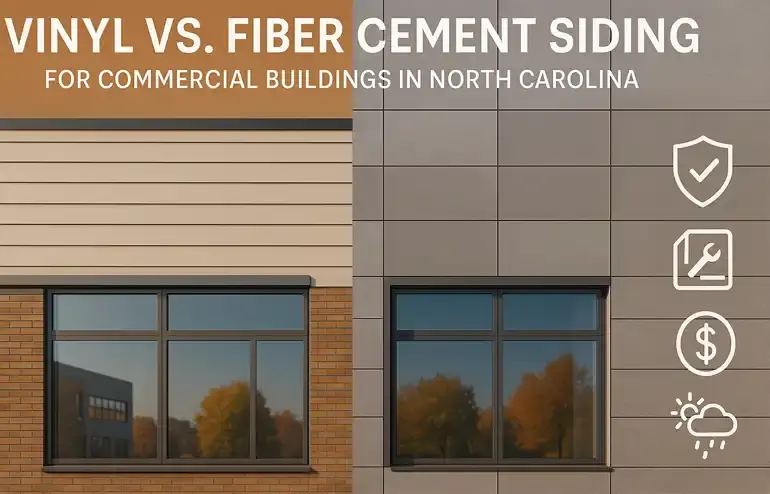
Choosing the right siding for a commercial building isn't just a matter of curb appeal. The material you pick has to stand up to North Carolina's heat, humidity, storms, and UV exposure for decades — all while keeping maintenance manageable and protecting your investment. Two of the most popular options for Triad commercial properties are vinyl and fiber cement. Here's how they compare across the factors that matter most.
Climate Compatibility and Performance
Vinyl Siding
Vinyl is a plastic-based material that resists moisture absorption and won't rot in humid conditions. The trade-off is that it's more prone to warping or softening when installed near high-temperature sources. Under heavy UV exposure its color can fade over time, and in extreme cold it becomes brittle and can crack on impact.
Fiber Cement Siding
Made from a blend of cement, sand, and cellulose fibers, fiber cement offers greater dimensional stability — it resists warping, shrinking, and swelling under heat or humidity. With a quality factory-applied finish, it holds its color against UV rays far better than vinyl. Because it's non-combustible, it also resists pests like termites.
Fiber cement handles heat, humidity, storms, and UV stress in North Carolina better than vinyl over the long run.
Longevity and Durability
Vinyl Siding
Vinyl siding typically lasts 20 to 30 years with good maintenance, and higher-end insulated vinyl can last longer. Hail, thermal cycling, and impact damage, however, can shorten its service life.
Fiber Cement Siding
Fiber cement generally lasts 30 to 50 years with proper installation and upkeep. Its thicker, more robust construction stands up to storms, impacts, termites, and fire — which makes it well suited to demanding commercial conditions.
Maintenance and Upkeep
Vinyl Siding
Vinyl asks very little of you. A simple soap-and-water cleaning is usually all it needs, and because the pigment runs all the way through the material, it never needs repainting.
Fiber Cement Siding
Fiber cement requires more attention, including repainting roughly every 10 to 15 years and occasional re-caulking. The upside is that thanks to its sturdy structure, that upkeep is largely cosmetic rather than structural.
Installation, Weight, and Labor
Vinyl Siding
Lightweight and easy to install, vinyl keeps labor costs down. The panels are simple to handle and cut, which makes vinyl a practical choice for covering larger facades efficiently.
Fiber Cement Siding
Fiber cement is heavier and more labor-intensive. Cutting it produces silica dust, so contractors need specialized tools and safety precautions — adding to both the cost and complexity of installation.
Aesthetic and Architectural Flexibility
Vinyl Siding
Vinyl comes in a wide range of colors and textures, though it can sometimes read as "manufactured." Changing the color down the road means replacing the panels entirely.
Fiber Cement Siding
Fiber cement can convincingly mimic wood, stucco, and other high-end finishes, and it can be repainted whenever the look needs a refresh. That gives it a more upscale appearance and far greater design versatility.
Cost and Return on Investment
Vinyl Siding
Vinyl has lower upfront material and labor costs, making it attractive for budget-conscious projects.
Fiber Cement Siding
Fiber cement carries a higher initial cost, but its longer lifespan and durability translate into stronger long-term ROI for commercial buildings.
At a Glance
- Climate resilience: Fiber cement holds up better to NC heat, humidity, and UV; vinyl resists moisture but can fade, warp, or crack.
- Lifespan: Vinyl 20–30 years; fiber cement 30–50 years.
- Maintenance: Vinyl is wash-and-go; fiber cement needs periodic repainting and caulking.
- Installation: Vinyl is lighter and cheaper to install; fiber cement is heavier and more labor-intensive.
- Looks: Fiber cement offers a more upscale, repaintable finish; vinyl is versatile but can look manufactured.
- Cost: Vinyl wins on upfront price; fiber cement wins on long-term value.
The Bottom Line
For most commercial buildings in North Carolina, fiber cement siding generally outperforms vinyl on durability, climate resilience, aesthetic flexibility, and long-term value. Vinyl still has its place — it's a smart fit for budget-conscious projects or auxiliary structures where upfront cost matters most. The right answer depends on your building, your timeline, and your budget.
Not sure which way to go for your property? Redeem Roofing & Construction installs both vinyl and fiber cement siding across Burlington, Greensboro, Winston-Salem, and the Piedmont Triad. We'll walk your building, talk through the trade-offs, and give you honest guidance. Get your free estimate today, or call us at (336) 350-1450.