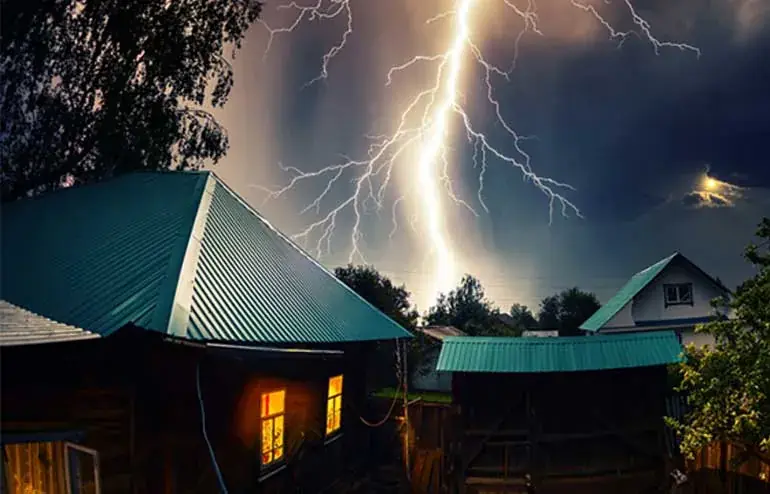
If you've been weighing a metal roof for your home in Burlington, Greensboro or anywhere across the Piedmont Triad, you've probably heard the old worry: metal conducts electricity, houses are tall, so won't a metal roof pull lightning out of the sky? It's a fair question — and a persistent myth. The reality is that metal roofs are struck no more often than any other roofing material, and once you understand how lightning actually behaves, the concern largely disappears.
The confusion almost always comes down to a single mix-up: people conflate attraction with conduction. Metal is an excellent conductor of electricity, that part is true. But conducting a charge is a completely different thing from drawing one toward you in the first place.
What Lightning Actually Is
Lightning is a rapid discharge of electrical energy in the atmosphere. It happens in three basic ways: within a single cloud (intra-cloud), between two clouds (cloud-to-cloud), or from a cloud down to the ground (cloud-to-ground). It's that last type that homeowners worry about.
Here's roughly how a cloud-to-ground strike forms:
- Inside a storm cloud, water droplets and ice churn and collide, separating positive and negative electrical charges.
- Negative charges gather at the base of the cloud, which in turn induces positive charges at ground level below.
- As the voltage between cloud and ground climbs, the air gap eventually becomes conductive and an invisible channel called a "stepped leader" begins reaching down toward the earth.
- Positive charges fire upward from the tallest objects on the ground to meet that leader. When they connect, electrons rush down and the channel lights up as the blue-white flash you see.
The key takeaway: where lightning lands is driven by topography, geography, storm movement, and the height of objects — not by what a roof is made of. A tall tree, a chimney, or a hilltop home is far more relevant to a strike than whether the roof is metal or shingle.
So Why Doesn't Metal "Attract" It?
Because attraction isn't about conductivity. Lightning seeks the path of least resistance to the ground, and it's already committed to a general location long before it reaches the last few feet of any structure. A metal roof doesn't reach up and grab a bolt that would otherwise have missed the house. Strike frequency comes down to how tall your home is relative to its surroundings — the same factor that applies to a home with asphalt shingles.
Metal roofs experience lightning strikes no more frequently than asphalt, slate, tile or any other roofing material. The material itself does not increase the odds.
What Happens If Lightning Does Strike
This is where metal's conductivity actually works in your favor. If a bolt does hit a metal roof, the material doesn't resist the charge — it channels it. Rather than holding onto that energy, a metal roof spreads the charge across its surface and directs it down toward the edges of the home, where framing and grounding can carry it safely to the earth. It's the same principle behind a lightning rod.
Two points are worth underlining here:
- Metal isn't combustible. Steel won't ignite from a lightning strike the way some materials can — though anything flammable nearby still could, so a strike is never something to shrug off entirely.
- Grounding matters. Because metal channels charge so effectively, many metal roof systems are intentionally grounded so a strike has a clear, safe route to the ground.
The Bottom Line
Metal roofs do not attract lightning. They aren't magically immune to damage either — no roof is — but the conductivity people worry about is the very thing that helps a metal roof handle a strike safely. Remember the distinction that clears up the whole myth: conduction is not attraction. A metal roof gives lightning a safe path down; it doesn't pull it out of the sky.
Thinking about a standing-seam or metal roof for your home in the Triad? Our team installs and repairs metal roofing across Burlington, Greensboro, Winston-Salem and the surrounding area, and we're happy to walk you through your options. Learn more on our metal roofing page, or request a free estimate and we'll answer every question — lightning included.